
West Virginia 2026 Voter Guide
Election Day is November 3. Here’s what you need to know.
While U.S. president isn’t on the ballot this year, there are a lot of other important races West Virginians will have a chance to decide in November. They include who should represent the state in the U.S. Senate and House of Representatives, as well as in key county commissioner roles. Every House of Delegates seat is up for election, and half of the State Senate seats as well.
Jump to:
Who can vote?
To register to vote in West Virginia, you must:
- be a citizen of the United States;
- live in West Virginia at the address on your application;
- be 18 years old on the day of the election;
- not have been judged “mentally incompetent” in a court of law;
- not be serving a sentence (including probation or parole) for a felony, treason or election bribery (people convicted of misdemeanors are eligible to vote).
How do you check if you’re registered?
You can search for your voter registration information on the Secretary of State’s website by entering your name and date of birth.
The deadline to register to vote in the General Election is Oct. 13, 2026. Here is information about how to register.
What do you need to bring to vote?
New this year: voters will be required to show a photo ID when they go to the polls. Last year, lawmakers passed a bill tightening the requirements. While voters used to be able to use a number of documents without photos for voter identification (including hunting and fishing licenses, food stamp cards or bank statements), now they’ll have to produce a document with both their name and image. County clerks and the secretary of state can also issue voter ID cards that meet these requirements.
How do you find your polling place?
You can search for your polling place on the Secretary of State’s website by entering your name and date of birth.
What are the key dates?
Deadline to register to vote in the General Election: Oct. 13, 2026.
Early in-person voting starts Oct. 21 and goes through Oct. 31. Every county has at least one location where you can vote during this period, generally the county courthouse or judicial annex. Here’s a list of early voting locations.
Election Day: Tuesday, Nov. 3, 2026.
Can you mail in a ballot?
West Virginians who meet one of the two following criteria are eligible to vote absentee: (1) confinement or not being present in the county during in-person voting, and (2) a permitted reason/excuse (which could include illness, immobility, work hours, and other reasons). Read more here.
If you plan to vote absentee, you must request an absentee ballot by Oct. 28. It must be either hand-delivered to the clerk’s office by Nov. 2, sent via mail without postmark and received by Nov. 4, or postmarked by Election Day (Nov. 3) and received by Nov. 9.
State constitutional amendment
Every West Virginia ballot will contain the following constitutional amendment:
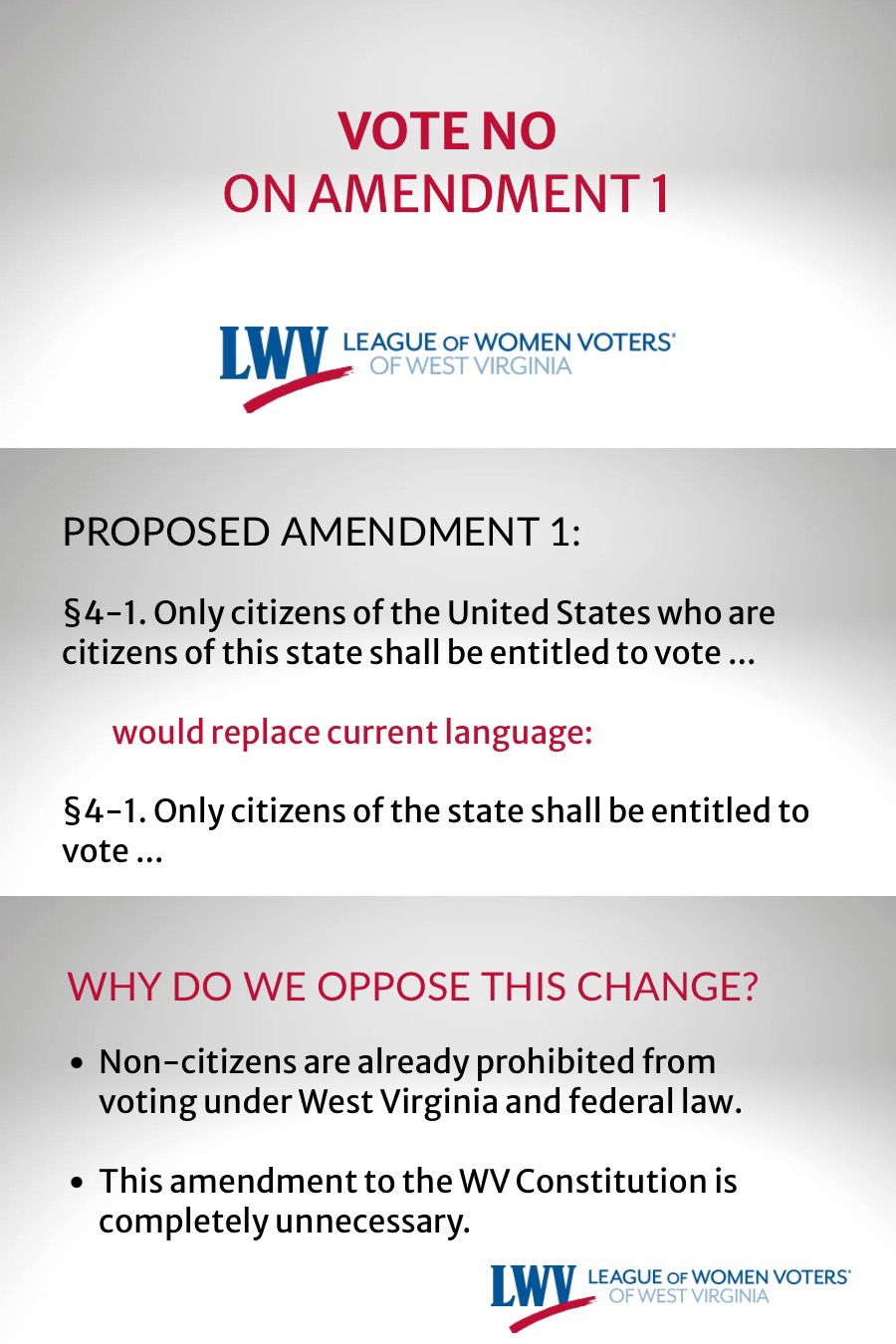
Summary of Purpose: This amendment provides that in all elections held in West Virginia only citizens of the United States who are citizens of this state are qualified to vote.
Instructions to Voters: To vote in favor of the Amendment submitted, darken the oval next to “FOR”. To vote against the Amendment, darken the oval next to “AGAINST”.
Noncitizens are already blocked from voting in West Virginia elections per state code. If a simple majority of more than 50% of voters approves this amendment, this would add the prohibition to the state constitution.
The resolution that put this measure on the ballot was sponsored by Sen. Patricia Rucker, R-Jefferson, and approved unanimously by both the state Senate and House of Delegates. Similar language is included in the American Legislative Exchange Council’s “Essential Policy Solutions for 2026,” and the amendment is supported by Americans for Citizen Voting, which advocates for similar policies around the country. It’s opposed by the League of Women Voters of West Virginia, which calls it “completely unnecessary.”
On the Record
This year, Mountain State Spotlight is introducing “On the Record,” a voter guide element to help you easily compare where candidates stand on issues that West Virginians told us were important to them.
We sent every state legislative and federal candidate a survey with statements. They were asked to rate their level of agreement with each statement, on a scale from 0 (“strongly disagree”) to 5 (“strongly agree”). In all, we heard back from a quarter of candidates and are displaying their responses in our individual county voter guide pages. When one candidate in a race responded and their opponent did not, we indicated that in the guide.
What candidates are on the ballot in every county?
In every county, voters will elect a U.S. Senator, a U.S. representative, as well as state senators and delegates. In many counties, there are also county and city positions including county commissioners, magistrates and city council members. Click your county to see these candidates, along with their responses, if any, to Mountain State Spotlight’s “On the Record” survey.
Any other questions?
Read more frequently asked questions here from the West Virginia Secretary of State’s Office.
If you see an error in our voter guide, or want to provide more information about one of the candidates, please email us at contact@mountainstatespotlight.org.
More election coverage
Jobs, education and political apathy: What Wood County residents are thinking ahead of the election
Ahead of the midterms, Wood County residents discuss job losses, education, political apathy and what they want from elected leaders.


As rural schools face closure, families in Raleigh and Mingo fear losing more than just classrooms
Raleigh and Mingo parents say small schools are best for their kids. But candidates say keeping them open isn’t part of their platforms.

Early voting has begun. Here’s what you should know before you head to the polls.
There are hundreds of names on ballots across West Virginia’s 55 counties as well as a constitutional amendment. They include candidates for the U.S. Senate and House of Representatives, as well as county commissioner roles.
This Republican tried to cap the Hope Scholarship. Out-of-state billionaires helped bankroll efforts to replace him.
A high-ranking Republican had wanted only to curb the unchecked growth of West Virginia’s voucher program, not destroy it. In the ensuing backlash, three PACs — affiliated with the Koch family and Jeffrey Yass — helped defeat him at election time.

We tried to find out where candidates stand on key issues. Most of them didn’t tell us.
To build our 2026 election voter guide, we reached out to more than 240 candidates asking them to share where they stood on issues that matter to West Virginians. 65 responded.
These young West Virginians want to build careers in the state. A lack of good jobs is forcing them to look elsewhere.
Scarce jobs, low pay and limited opportunities are pushing young West Virginians to move to other states.
