


Nearly three weeks ago, near an Interstate 77 tollbooth, State Police stopped three people, pulled at least one out of the vehicle and called U.S. Immigration and Customs Enforcement (ICE).
The man pulled from the vehicle, Venezuela citizen Antony Segundo Larrazabal-Gonzalez, was arrested. He was taken first to Southern Regional Jail, then an ICE detention center in Poca and finally to South Central Regional Jail.
Damary Alejandra Rodriguez Flores was also in the vehicle and was arrested. She had fled Honduras, which still hasn’t recovered from the thousands of deaths and widespread damage caused by a 1998 hurricane.
So far, this week, in two scathing opinions, U.S. District Judge Joseph R. Goodwin ordered both Larrazabal-Gonzalez and Flores released.

Goodwin found that federal agents wrongly jailed them. Both were cooperating with immigration officials. They had not been found to pose a threat to the community, or to national security.
Larrazabal-Gonzalez, who lives in Atlanta, had built a new life in America, and was attending immigration proceedings, according to court records. Flores lived with her husband, a roofer, in Charlotte, N.C. Goodwin said he was shocked that he was presented no evidence for why the pair should remain jailed. A government lawyer repeatedly responded, “I don’t know” to the judge’s questions.
“There’s not a shred of evidence to support the government’s position,” Goodwin said during the hearing. “Not one iota. Not a jot or a tittle.”
Over the last month, President Donald Trump’s immigration crackdown has come to West Virginia.
ICE agents have raided Mexican restaurants, taken immigrant workers off a Hurricane rooftop and picked up nine people while directing traffic at Fayetteville’s annual Bridge Day celebration.
In Charleston, elected officials are working to support Trump’s campaign, while many state residents have rallied to support immigrant neighbors.
A growing number of immigrants are challenging the crackdown’s tactics. Since Jan. 15, about a dozen of them have gone to court, demanding to be released.
Such cases haven’t been common in West Virginia — until now — and more are expected to be filed.
Those bringing the suits include immigrants seeking legal citizenship and fleeing persecution, and who had been released near the border after being found not to be dangerous or flight risks, according to a review of their court filings and interviews with lawyers.
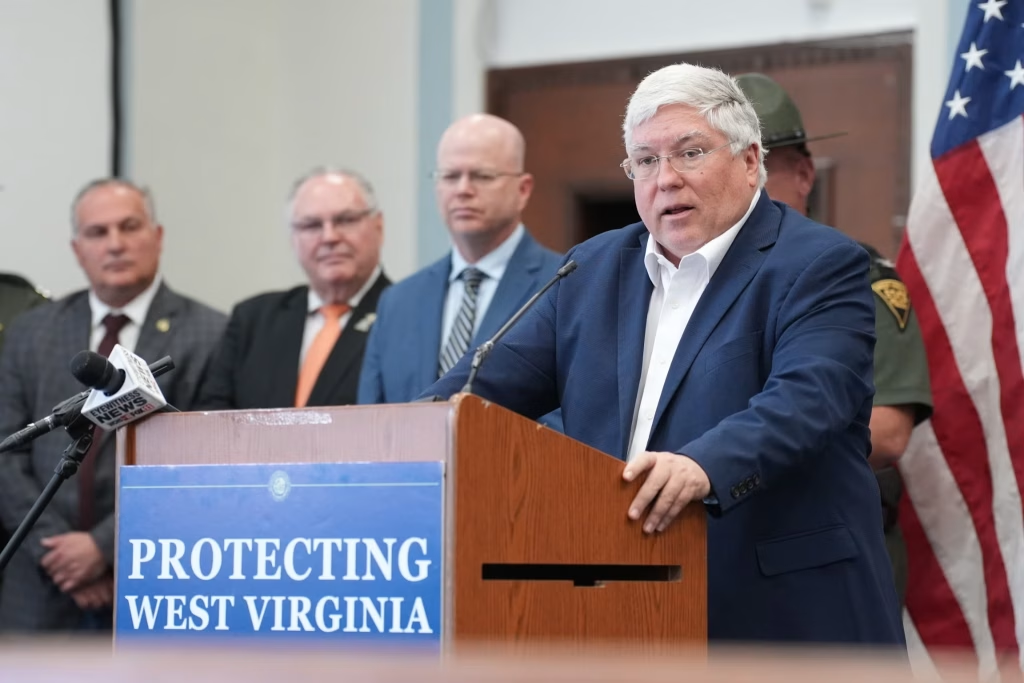
Gov. Patrick Morrisey’s office did not respond to requests for the numbers of arrests with which the state had assisted. Then late Friday, ICE issued a press release to tout having arrested 650 immigrants in West Virginia in a two-week period in early January.
The release quoted Morrisey saying the arrests “have removed dangerous illegal immigrants from our communities and made our state safer for families and law-abiding citizens.”
A separate statement from U.S. Attorney Moore Capito — whose office couldn’t answer Goodwin’s courtroom questions — called “Operation Country Roads” a “clear demonstration of the strength, discipline, and resolve of our state and local law enforcement partners.”
But, the court challenges in West Virginia reflect the growing national concerns that Trump’s efforts to expand immigration enforcement plainly contradict basic constitutional principles that limit the government’s ability to jail human beings without good reason.
“Despite what some may have been led to believe, immigrants illegally in this country enjoy protections guaranteed by the Fifth Amendment,” Goodwin wrote in one of his rulings. “In our society, freedom is the constitutional default.”
Across the country, more than 300 judges have ruled against the Trump administration’s effort to quickly jail immigrants, according to reporting by Politico.
Goodwin said that, because of the many lawsuits surrounding ICE actions, he could not view the cases in his court outside of the national, political and legal context.
“Across the country, federal immigration enforcement operations have sparked controversy and concerns about constitutional overreach,” the judge wrote. “In Minneapolis, federal immigration and border agents have been involved in multiple fatal shootings of U.S. citizens. Those events have prompted widespread protest and calls for accountability.”
ICE raids come to West Virginia
In early January, West Virginians began posting all over social media about ICE sightings and arrests in their communities.
In Morgantown, Mayor Danielle Trumble and City Councilor Brian Butcher acknowledged the surge on Facebook and asked residents to “check in with your neighbors, support your local businesses, and show extra love and kindness to your friends and others close to you.”
Del. Kayla Young, D-W.Va., posted on Facebook, “Across our state and country, undertrained and overresourced ICE agents are unlawfully detaining people with harmful tactics, zero transparency, and no accountability.”
Immigrants and supporters have been alerting each other when they spot ICE agents.
And immigration lawyers, few and far between in the state, are conducting limited “know your rights” training for alarmed immigrants who “desperately need advice,” said Ocklawaha “Wabby” Holt, of Mountain State Justice.
She said immigrants have even been picked up while trying to work toward citizenship at courthouses.
“They’re doing things the right way,” she said.
On Jan. 24, during an immigration enforcement operation in Minneapolis, U.S. citizen Alex Pretti, a nurse, was killed, sparking even more national outrage following the Jan. 8 shooting and killing of Renee Good, a volunteer legal observer.

In its statement Friday, ICE said the West Virginia arrests included “a convicted child sex abuser, a criminal convicted of drug possession charges, and many others.” But the agency did not include how many others, of the hundreds arrested, had criminal convictions.
Goodwin cautioned in one of his rulings that, “It is not the vigilance of detainees or the speed of their lawyers that determines what is and what is not constitutional. Liberty is not a prize for procedural persistence. It is the baseline.
ProPublica has found that the vast majority of the people subject to mass deportations since Trump took office a year ago had no criminal convictions in the United States, despite the president saying he was targeting “the worst of the worst.”
Controversy at the Capitol
In mid-January, state lawmakers convened in Charleston for the 2026 legislative session.
That evening, in his State of the State address, Morrisey praised Trump’s immigration crackdown.
“Isn’t it great to have a president, Donald J. Trump, who enforces our borders?” the governor said.
And in the West Virginia House of Delegates, lawmakers quickly passed a bill to create a new state crime for anyone who helps an immigrant avoid being detained by authorities. Such actions are already a federal crime.
Del. JB Akers, R-Kanawha and a sponsor, said the bill remains important and it’s not in response to recent crackdowns.

The Senate passed a bill to keep West Virginians 30 feet from first responders.
Sen. Joey Garcia, D-Marion, cautioned that could keep people from filming law enforcement activity to hold agents accountable.
Sponsor Sen. Mike Oliverio, R-Monongalia, said smartphones are capable of filming from 30 feet, and State Police said the bill was needed to give them time to respond to aggressors.
But after Goodwin’s two rulings, a partner at a prominent West Virginia-based law firm issued a warning to businesses about the rights of their employees in the event of ICE raids in their workplaces.
“Employers in West Virginia may face a situation where their employees who are immigrants are arrested and detained by immigration officials,” Jackson Kelly partner Tom Hurney wrote. “Two new opinions from the United States District Court for the Southern District of West Virginia makes clear that all persons are entitled to due process when arrested and detained.”
Noncitizens have rights
On Wednesday, Danny Briceno Solano’s body shook as he sat in Chief U.S. District Judge Thomas Johnston’s courtroom. Solano wore pants and a shirt in inmate orange. His wrists were chained together.
READ MORE

Update: More ICE detainees ordered released by West Virginia judges: ‘A threat to anyone’s constitutional rights is a threat to us all’
Two different federal judges have ordered three more immigrants picked up in January’s ICE raids released on constitutional grounds

Johnston was holding a hearing over whether to release Solano and another immigrant, Frezgi Kelete Mehari, a long-haul truck driver. Both men were detained by ICE while traveling I-77 earlier this month.
For 10 days, Solano had waited in South Central Regional Jail in Charleston for his day in court and a chance at freedom.
The result of this hearing in the federal courthouse in Charleston could send him back to Venezuela.
Johnston has not yet ruled, but like Goodwin, he was skeptical of the government’s actions. Goodwin was appointed by President Bill Clinton, and Johnston by President George W. Bush.
Noting Goodwin’s rulings a day earlier, Johnston urged the two sides to work out a settlement. A two-hour meeting produced no such deal, and Johnston went ahead with a hearing.
Lawyers for the immigrants argued the men weren’t dangerous. Not flight risks. Not criminals. And seeking citizenship through the proper channels.
Assistant U.S. Attorney Chris Arthur didn’t want to talk about the arrests. He wanted to talk about the detentions. He was puzzled as to why Johnston needed more info about the arrest.
Johnston responded that evidence related to the legality of the arrests was central to the case — if the arrests hadn’t happened, the immigrants wouldn’t be detained. Like Goodwin, Johnston wanted to know the reasons Mehari and Solano were stopped in the first place, and what evidence ICE agents had for detaining them.
Finally, the judge raised his voice.
“I want to know what happened on I-77!”
He didn’t get answers.
Correction, Jan. 31, 2026: This story was updated to reflect that Mayor Danielle Trumble and City Councilor Brian Butcher are in Morgantown.